Your Brain Has Two Operating Systems—and One of Them Is Lazy
For education and self-reflection only — not medical, psychological, or psychiatric advice. If you're in distress, please talk to a licensed professional. Full disclaimer.
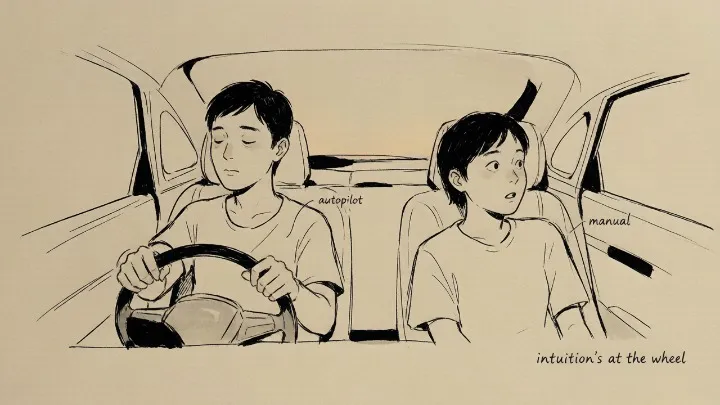
We think reason is driving. Intuition has been at the wheel the whole time.
TL;DR
Here’s the hard truth. Reading about cognitive bias doesn’t protect you from cognitive bias. Kahneman spent fifty years cataloguing these errors and still caught himself making them. The self-deception isn’t “I don’t understand this.” It’s “now that I understand it, I’m exempt.” You’re not. System 1 doesn’t retire just because you learned its name. What this book actually gives you is one thing: a pause. One beat longer before you commit.
What are System 1 and System 2?
Think of your brain as two people sharing the driver’s seat.
System 1 is autopilot. It’s fast, effortless, always on. You see 2+2 and “four” appears before you can blink. You hear a sudden noise and your head turns automatically. Someone frowns and you know they’re upset without a second of analysis.
System 2 is manual control. It’s slow, effortful, and needs to be summoned. Calculating 17×24 in your head. Focusing on one voice in a noisy room. Weighing a major decision — that’s System 2 clocking in.
Kahneman’s discovery wasn’t that these two systems exist. People had noticed that before. His insight was more unsettling: we believe System 2 is in charge of our lives. System 1 has been running the show the entire time.
Why is this discovery uncomfortable?
Because System 1 is a pattern-matching machine. It doesn’t analyze or verify — it just slots whatever’s in front of it into the closest available pattern and reports back: “this is what’s happening.”
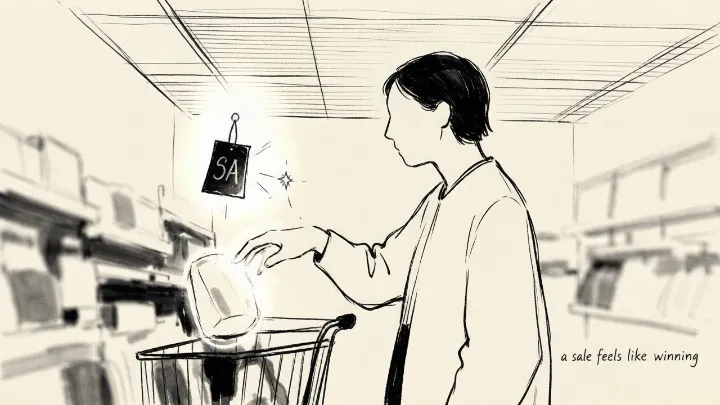
That’s why a sale feels like winning, even when you didn’t need the item. Why you trust someone more because your first impression was good. Why watching one plane crash on the news makes flying feel dangerous, even though the data says it’s far safer than driving.
System 1 is brilliant for survival — if something looks like a snake, you jump first and figure out it’s a rope later. That algorithm kept our ancestors alive. But when the problem is an investment decision or a relationship dynamic, System 1 is still running the same “jump first” code.
The six biases worth knowing by name
Kahneman catalogued dozens. These six explain most of the damage, and all of them do their work before you notice anything happened.
Anchoring. The first number you hear sets the range you negotiate inside. A $2,000 jacket marked down to $800 feels cheap. At no point did you ask whether you wanted a jacket.
Availability. You judge probability by how easily an example comes to mind. Plane crashes are vivid and televised, so flying feels riskier than driving. The base rates say otherwise. Your nervous system doesn’t care.
Loss aversion. Losses land roughly twice as hard as equivalent gains. This is why people hold a losing position far too long and sell a winning one far too early — in portfolios, and in relationships.
The halo effect. One strong impression bleeds into unrelated judgments. He’s articulate, so he must be honest too. She was kind once, so she can’t have meant it that way.
WYSIATI — What You See Is All There Is. System 1 builds a coherent story out of whatever is in front of it and treats missing information as if it never existed. You’re not weighing the evidence. You’re weighing the evidence that happens to be in the room.
The planning fallacy. You estimate how long something will take based on how it should go, not on how similar things actually went. Every late project in history began as a confident estimate.
None of these feel like errors from the inside. That’s the point. A bias you can feel isn’t a bias — it’s a preference. The whole mechanism depends on the conclusion arriving already wrapped as certainty.
Where this bites in relationships
This is the chapter most summaries skip, and it’s where the book earns its keep.
Anchoring in an argument. Whoever speaks first sets the frame. If the opening line is “you’re overreacting again,” everything after it becomes a defense against that claim instead of a discussion of what happened. The frame won before the content arrived.
Halo effect on someone who hurt you. They were extraordinary in the beginning, so the bad behavior gets filed as an exception instead of read as information.
Loss aversion in a relationship that isn’t working. You stay because leaving feels like losing everything you already put in. Kahneman’s framing cuts straight through this: sunk cost isn’t a loss you’re avoiding. It’s already gone. The only live question is what the next year costs you.
WYSIATI in every fight you’ve ever had. You have complete access to your own intentions and almost none to theirs. So your version of the argument is always more complete than their version. That asymmetry feels exactly like being right. It’s just being better informed about one side.
One line worth drawing: a bias is something you do to yourself. If someone in your life has been steadily rewriting your version of events, that’s not a bias — that’s a tactic, and it’s worth naming separately. See the mechanics of gaslighting and the patterns that go past simple arrogance.
How do you get System 2 to show up more often?
You can’t keep it online all day — it burns too much energy. But you can wake it up at key moments.
First, pause when you feel completely certain. System 1’s most dangerous move is making you feel like you don’t need to think anymore. If a judgment arrives unusually fast and feels unusually solid, System 1 is probably doing your thinking for you.
Second, sleep on important decisions. System 1’s intuition doesn’t factor in time. Letting a night pass gives System 2 a chance to quietly review things in the background.
Third, ask yourself: am I reacting to a story or to data? A moving interview on the news will sway your judgment more than a statistic — but the interview is one person’s experience, and the statistic represents thousands.
Fourth, change the setup instead of your willpower. System 2 is expensive, so don’t rely on summoning it through effort. Write the decision down. Show it to someone who has no stake in the outcome. Put a delay between the impulse and the action. Correction happens in the setup, not in the moment.
One thing you can do tonight
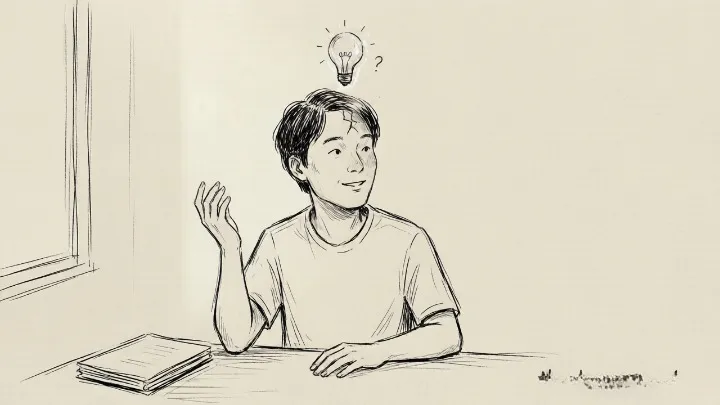
Pick a decision you already feel settled about — a purchase, a reply you’re about to send, a commitment you’re about to make. Before you act, write down two lines:
- “The three ways this could go wrong are…”
- “If this turns out badly a year from now, the most likely reason will be…”
Gary Klein developed this as the pre-mortem, and Kahneman championed it in the book. The trick is that it forces System 2 into a room System 1 already declared closed. Imagining failure gives you permission to look for causes you’d otherwise skip, because inside the scenario the failure has already happened and nobody’s ego is on the line.
Two minutes. It won’t make you rational. It’ll make you one beat slower, which is usually the same thing.
System 1 in the age of the feed
Kahneman wrote this book in 2011, before your phone was a slot machine. Which is why this part is worth adding yourself, because the book only half predicted it.
The feed is System 1’s dream environment. It’s fast, it’s visual, it never asks you to compute anything, and it delivers the next stimulus the instant the last one lands. Everything in it is engineered for the autopilot — the autoplay, the infinite scroll, the notification shaped to hijack attention before System 2 can even consider clocking in.
Here’s the uncomfortable part. The algorithm doesn’t just exploit your biases. It learns them and feeds them back to you. Every hesitation, every linger, every “one more video” is a data point. Over time the feed stops showing you reality and starts showing you the version of reality your System 1 already finds easiest to believe. Anchoring, availability, WYSIATI — all of it gets automated.
That’s the difference between the book’s world and yours. Kahneman’s biases fired when you weren’t paying attention. Now there’s a machine whose entire job is to make sure you never start. The pause is still the defense. It just has a much better-funded opponent now.
FAQ
Is System 1 always wrong? No. It’s right most of the time, which is exactly why trusting it feels justified. The failures cluster in specific conditions: unfamiliar stakes, strong emotion, time pressure, and the feeling of total certainty.
Can you train System 2 to run more? Not through effort. It’s cheaper to change the environment around the decision — slow it down, write it out, sleep on it, loop in someone with no stake. Recognition happens in the moment; correction happens in the setup.
Why do smart people fall for this? General intelligence doesn’t protect against these errors. Kahneman found that statistical training helped more than raw IQ, and even then, knowing the list isn’t immunity. He said so about himself, repeatedly.
Does knowing this actually change anything?
Honest answer: knowing doesn’t equal doing. Kahneman spent a lifetime studying cognitive biases and still fell for them.
But knowing gives you a small pause button. The next time you hear yourself say “I’m absolutely certain about this,” a quiet voice might respond: that’s System 1 talking. The doubt itself — that flicker — is System 2 waking up.
It won’t make you a better person. It’ll make you a worse liar to yourself, which is a decent start.
Related reading
- The mechanics of gaslighting — when someone rewrites your version of events
- Attachment styles: the four ways we love
- The science behind intuition
If you’ve caught yourself defending a decision you can’t fully explain, get a second opinion from someone with no stake in the outcome. Not because a stranger knows better than you — because you already know how unreliable you are at grading your own reasoning.
You can also browse readers on Psychicoz if you want a different angle on a decision you’re too close to.
Core insight from Daniel Kahneman, Thinking, Fast and Slow. The book also unpacks anchoring, loss aversion, regression to the mean, and dozens of other cognitive quirks worth knowing about.