7 Signs of a Narcissist That Go Beyond 'Arrogance'
For education and self-reflection only — not medical, psychological, or psychiatric advice. If you're in distress, please talk to a licensed professional. Full disclaimer.
TL;DR
Here’s the hard truth. You are not actually trying to figure out whether he’s a narcissist. You’re trying to figure out whether you’re allowed to leave. The diagnostic label is just the version of that question you can ask without having to hear the answer. Naming the pattern feels like progress. It isn’t. It’s the most respectable form of waiting.
It’s not arrogance. It’s a self so fragile it can’t survive without constant outside validation.
What is narcissistic personality disorder, really?
Most people think it means being self-obsessed. That misses the point.
The core of narcissistic personality isn’t loving yourself too much. It’s needing continuous external attention and approval to hold together a fragile sense of self. More praise than most people could use. A tolerance for criticism that falls apart under mild pressure. And a striking inability to register what other people are feeling.
This isn’t selfishness. Selfishness means you know what someone needs and choose not to give it. Narcissism means you never registered the need in the first place.

What are the signs worth paying attention to?
1. The early-stage magnetism is almost too much. Exceptionally good at mirroring, reflecting back whatever you like and becoming that person for a while. It’s not an act in the usual sense. They believe it too, right up until they don’t. This charm pulls people in fast, but it’s sprinter energy. It doesn’t run marathons.
2. Every conversation eventually orbits back to them. You share something painful; they tell you about something worse. You share an accomplishment; they one-up it. It’s not empathy followed by “I’ve been there too.” It’s “my turn now.”
3. Criticism registers as an attack. Even mild feedback, like “could you call a bit later, I’m exhausted tonight,” gets processed as wholesale rejection. What follows is rage or the silent treatment. Same function, different costume.
4. There’s no internal guilt mechanism. They can apologize. Nothing changes afterward. The apology is a tool. It’s not a feeling.
5. They have a constant need for superiority. Not winning competitions. Winning the contest of who’s more right, who’s suffered more, who’s been more misunderstood. In a relationship that shows up as endless comparison and put-downs small enough to deny.
6. Your boundaries get eroded systematically. Not one dramatic violation. A pattern. You accept one unreasonable request today; tomorrow’s is worse. You think you’re compromising. You’re being conditioned.
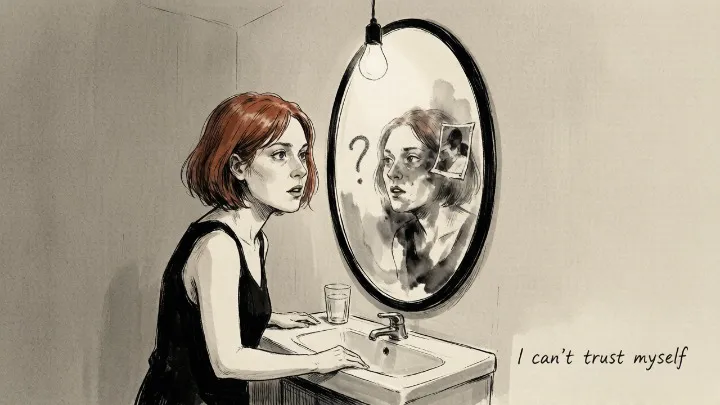
7. When you finally leave, you wonder if you were the problem. This is the dangerous one. Long-term exposure to a narcissistic dynamic produces what clinicians call cognitive fog. You stop trusting your memory, your feelings, your version of events. “Maybe I was too sensitive” becomes your default setting.
Why the label is the trap
Here’s where most articles stop, and it’s exactly where the real problem starts.
You read the list. You recognize six of seven. And then something odd happens: instead of acting, you go looking for more certainty. You read another article. You bring up the word “narcissist” in an argument to see how he reacts. You make a mental tally. You start researching covert narcissism, because the first label didn’t fit cleanly.
Collecting evidence is work that feels like progress and requires no decision.
That’s the appeal. Asking “is he a narcissist” is a question with an endless research phase. Asking “can I live with this exactly as it is today” is a question you can answer in ten seconds, and the answer scares you. So you pick the question that stays open.
Clinical psychologist Ramani Durvasula, who has spent her career on narcissistic abuse recovery, keeps returning to the same reframe: the useful question isn’t “will they change?” It’s “can I live with them as they are right now?” That question doesn’t need a diagnosis. It needs an honest Tuesday.
Why the most empathic people get caught hardest
There’s an assumption that narcissistic dynamics prey on the weak. The opposite is closer to true.
Empathy is the entry point, not the vulnerability. If you’re good at understanding why people do what they do, you can build a generous explanation for almost any behavior. He blew up because he’s stressed. He disappeared because he’s scared of intimacy. He one-upped your promotion because he’s insecure.
Every one of those explanations might be true. That’s the problem. Understanding someone’s wounds is not the same as agreeing to absorb the damage. A long trail of accurate explanations can land you in exactly the place you swore you’d never be.
W. Keith Campbell’s work on narcissism frames it as a self-regulation strategy: the grandiosity isn’t a personality quirk, it’s a system for keeping an unstable self steady. Your attention is the fuel.Understanding that makes the pattern legible. It does not make you responsible for running the pump.
What do you do if you’re in a relationship like this?
If you keep feeling “I’m becoming less and less myself,” trust that feeling before you try to analyze it.
Step one isn’t leaving. It’s recovering your own judgment. Tell a trusted friend the full story. Don’t make excuses for him. Don’t fill the gaps with generous interpretations. Just notice: does the relationship sound different when you say it out loud? If you hear yourself and it sounds off, it is off.
Step two: set one small, specific boundary. “I’m not taking calls Thursday and Friday evenings.” Don’t negotiate it. Don’t justify it. State it once and watch what happens. A healthy person respects it. A narcissistic pattern challenges it, with emotion, with logic, with guilt. The method varies. The goal is always to make your boundary fail.
Step three, and this is the one people skip: keep a record of facts, not feelings. After a fight, write down what was actually said, in order, while it’s still fresh. Not “he made me feel crazy.” Write “he said the conversation never happened. I have the text thread from Tuesday.” Feelings can be argued with. Timestamps can’t. This isn’t building a case against him. It’s rebuilding the reference point you’ve been trained to distrust — the same mechanism that makes Gaslighting: 12 Phrases That Reveal Someone Is Rewriting Your Reality worth reading next.
The clinical picture (and why “narcissist” is overused)
In clinical terms, narcissistic personality disorder (NPD) is a specific diagnosis. The DSM-5 describes it through three overlapping themes: a grandiose sense of self-importance, a deep need for admiration, and a notable lack of empathy. Patterns that begin by early adulthood and show up across contexts, not just at home.
But here’s the nuance the internet usually skips: traits and disorder aren’t the same thing. Almost everyone carries some narcissistic traits. A bit of defensiveness, a dash of ego. That’s being human. NPD sits on the far, rigid end of that spectrum, and only a qualified clinician can diagnose it.
There’s also a distinction worth knowing: grandiose vs. covert narcissism. Grandiose is loud: charming, dominant, “look at me.” Covert is quiet: the martyr, the perpetual victim, the person who weaponizes guilt and self-pity. Covert patterns get missed precisely because they don’t match the stereotype. They wear humility like a costume.
Related: narcissistic control usually runs on gaslighting. If phrases like “that never happened” sound familiar, read Gaslighting: 12 Phrases That Reveal Someone Is Rewriting Your Reality. And if the pattern you’re tracking looks more like distance than dominance, check When Your Partner Pulls Away.
Digital manipulation: the same game, new costume
There’s a version of this dynamic that didn’t exist a generation ago, and it’s worth naming because it’s easier to miss. The tools changed. The pattern didn’t.
An algorithm learns your insecurities faster than a partner can. It watches what you linger on, what you stop scrolling to read, what you buy at 2 a.m. Then it feeds you exactly the validation-and-comparison cycle that keeps a fragile self seeking. It’s not malevolent. It doesn’t need to be. Attention is the fuel, and the machine is just better at pumping it than any human ever was.
AI-generated sweetness is cheap now. The kind of charm that used to take a person — the mirroring, the “I understand you like no one else,” the perfectly tuned flattery — can be produced at scale, instantly, with no one on the other end getting tired. Which makes the real tell even more important: is there someone here who can actually be hurt, or just a mirror that reflects what I paid it to reflect?
The giveaway hasn’t changed. A narcissistic pattern — human or algorithmic — does the same two things: it needs your attention continuously, and it can’t tolerate you having an interior it doesn’t control. Whether that shows up as a partner who one-ups your good news, or a feed that’s learned to always keep you slightly hungry, the signature is identical. If something in your life only ever makes you feel good when you’re giving it your attention, ask whose fuel you’re running on.
What if you’re not sure whether it’s them or you?
This is the question that keeps people stuck. A useful test:
- It’s a pattern, not an incident. One bad fight isn’t a diagnosis. A pattern of mirroring-then-devaluing, boundary-eroding, and blame-shifting is.
- Your confusion is itself a signal. Long-term exposure to this dynamic reliably produces self-doubt. If you spend most of your time trying to determine whether you’re “too sensitive,” that’s not proof you are. It’s a symptom of the dynamic.
- Say it out loud to someone you trust. Patterns that feel normal inside your head often sound obviously wrong the moment they leave your mouth.
If you’re looking for certainty, you won’t find it from the inside. Get an outside perspective, ideally a therapist rather than a friend who already agrees with you, because the whole structure of the relationship is built to make your own judgment unreliable.
There’s a reason for that unreliability, and it isn’t weakness. Under sustained pressure, your brain starts treating their version of events as the cheaper option. Arguing costs energy; agreeing costs less. That’s not a character flaw, it’s the same cognitive economy Kahneman maps in Thinking, Fast and Slow, running in the least convenient place possible.
When should you get outside help?
When you start believing things like “this is just how relationships are,” “all love is painful,” or “I probably don’t deserve better.” Those aren’t your beliefs. They’re the product of sustained psychological pressure. At that point, climbing out of the cognitive fog alone is close to impossible, and pretending otherwise is part of how the fog works.
If you’re looking for a second read on a pattern you’re too close to see, love and relationship readers on PsychicOz will give you an outside perspective. Treat it as exactly that. A stranger’s read on your situation is not a diagnosis and not a substitute for a licensed therapist, and anyone who tells you otherwise is selling something.
If the fog has gotten thick enough that you’re doubting your own memory, that’s the line where a straight-talking advisor on Oranum is the wrong tool. Find a therapist in your jurisdiction. This article is not a treatment plan.
Frequently asked questions
Is “narcissist” the same as NPD? No. “Narcissist” is a colloquial label for someone with high narcissistic traits; NPD is a clinical diagnosis with specific, pervasive criteria. Most people you’d call narcissistic don’t have a diagnosis. They don’t need one for their behavior to be harmful.
Can a narcissist change? Change is possible but rare, partly because the condition is defined by an inability to tolerate the vulnerability that change requires. The realistic question isn’t “will they change?” It’s “can I live with them exactly as they are right now?”
What’s the difference between confidence and narcissism? Confidence doesn’t need you to shrink. A confident person can celebrate your win; a narcissistic person experiences it as a loss. Confidence is self-assured. Narcissism is self-preoccupied, and threatened by anything that isn’t.
What should I do if I think I’m the narcissistic one? Wondering about it is already a meaningful difference. Genuine narcissism rarely includes that kind of self-doubt. If the pattern concerns you, bring it to a therapist. Not to flagellate yourself, to find out.
Why do I keep going back after I’ve decided to leave? Because the version of them you fell for shows up right when you’re about to go. That’s not a coincidence and it’s not love winning out. It’s the pattern working as designed. Deciding while you’re being charmed is deciding inside the system. Make the call when they’re not in the room.
This article is part of our relationship cluster. Start with Attachment Styles: The 4 Ways We Love, or read Gaslighting to understand the control tactics that often accompany narcissism.