When Your Partner Keeps Pulling Away: The Psychology Behind Avoidant Attachment
For education and self-reflection only — not medical, psychological, or psychiatric advice. If you're in distress, please talk to a licensed professional. Full disclaimer.
TL;DR
Here’s the hard truth. You are not married to a distant man. You are married to a frightened one, and the two look identical from the outside. That’s why everything you’ve been trying — the leaning in, the talking it through, the wanting more — has been making it worse. You’ve been responding to the surface. The person you actually love is on the other side of a reflex that fires before thought does.
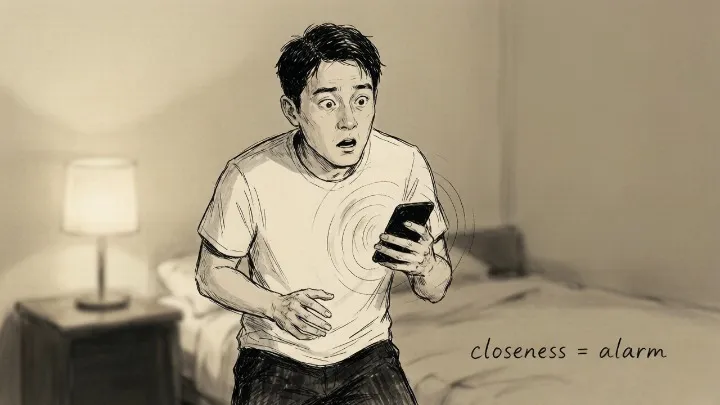
It’s not a lack of love. It’s closeness itself that sets off the alarm.
What does avoidant attachment actually look like in a relationship?
The defining trait isn’t “not caring.” It’s fear of being too close.
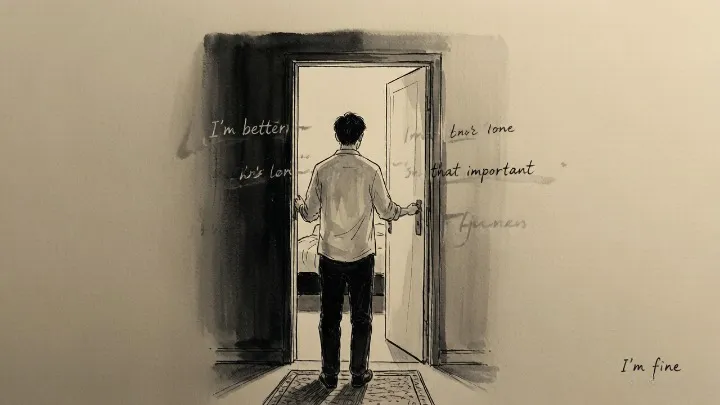
The closer you get, the more he retreats. You send three paragraphs; he replies with a thumbs-up. After an argument, you want to talk it through; he says “I’m fine” and shuts the bedroom door. He doesn’t experience this as the silent treatment. He experiences it as an inability to handle the pressure of being needed.
Avoidant attachers learn one rule early in life: depending on people is unreliable. Better to handle things alone. By adulthood, that rule has calcified into an unspoken message: nobody gets too close.
What’s the psychological mechanism behind the pulling away?
It has almost nothing to do with how much he loves you. It’s an automatic response.
When intimacy escalates — someone cries, expresses strong emotion, asks for deeper commitment — his nervous system registers danger and activates retreat. The thinking brain doesn’t get a vote. By the time he could reflect on what’s happening, he’s already gone.
Psychologists call this deactivation. The moment closeness feels threatening, the brain automatically suppresses attachment needs and downgrades the partner’s importance. “She’s not that important anyway.” “I’m better off alone.” These thoughts aren’t his actual assessment. They’re a self-protection script running on autopilot.
The part the advice always skips: what the chase is doing to you
Every article about avoidant partners hands you the same list — stop chasing, give space, don’t take it personally. What none of them say out loud is what this arrangement is costing the person on the other end.
You are being asked to shrink your needs to fit a person who was taught that needs are dangerous. You stop asking for reassurance because asking gets you distance. You learn to celebrate the emoji. You downgrade “I need to talk” to “it’s fine” because the real sentence is too expensive.
Over time, that’s not patience. That’s you quietly training yourself out of wanting. And there’s a name for what comes next: it’s the same erosion of your own judgment that shows up in Gaslighting: 12 Phrases That Reveal Someone Is Rewriting Your Reality. Nobody is lying to you. The effect is still the same — you stop trusting whether your needs are legitimate.
Understanding his attachment system is useful. It is not the same as agreeing to run on empty while you wait for a reflex to rewrite itself.
What can you actually do about it?
First, stop chasing. The chase fuels your anxiety and sharpens his defenses. He pulls back; you lean in; the spiral gets worse. Pause. Give space.
Second, trade accusations for observations. “Why won’t you talk to me?” lands as an attack. “I notice you might need some space — I’m here whenever you want to talk” is a door instead of a wall.
Third, make coming back feel less costly. If he returns to a calm response instead of an anxious interrogation, his brain slowly starts revising the equation: closeness does not equal danger.
Fourth, and this is the one that gets left out: decide what you need while the pattern is stable. Don’t evaluate the relationship in the middle of a retreat. Pick a calm Tuesday. Ask yourself one question, honestly: if this exact rhythm — close, then gone, then close — is the best it ever gets, do I stay? Your answer on a calm Tuesday is the truest data you have. The answer you give while he’s pulling away is fear; the answer you give while he’s back is relief. Neither is reliable. The Tuesday one is.
When should you consider professional help?
If you’ve tried the approaches above and the loop keeps spinning — every approach triggers retreat, every retreat deepens your anxiety — the pattern has likely gone beyond what the two of you can break alone.
When the push-pull has gone on for months. When your anxiety is bleeding into other parts of your life — sleeplessness, inability to focus, work slipping. When the retreat has turned into belittling or emotional withholding. These aren’t communication problems anymore.
A relationship counselor can give both people a third space that feels safe. For avoidant-attachment dynamics, that matters because the safe space between the two of you may no longer exist. That’s not a failure on your part. It’s the definition of the problem.
The science behind the retreat
Avoidant attachment was first described by Mary Ainsworth, who observed that some infants, when their caregiver returned after a separation, would avoid contact — looking away, staying busy, acting as if the caregiver weren’t there. Their stress didn’t disappear; it was suppressed. The behavior wasn’t indifference. It was a learned self-protection: don’t reach for what isn’t reliably there.
Bowlby’s framework makes the same point: when a child’s needs are repeatedly met with rejection or dismissal, the adaptive response is to shut the need down at the source. By adulthood, that internal shutdown shows up as the classic avoidant script — “I don’t really need anyone,” “relationships are more trouble than they’re worth,” “I do better alone.”
The insight that matters for a partner: the withdrawal is not a verdict on your worth. It’s a decades-old reflex. Understanding that doesn’t excuse hurtful behavior, but it does change what you’re actually dealing with.
For the big picture, read Attachment Styles: The 4 Ways We Love.
How to tell avoidance apart from “he’s just not that into you”
This is the question every partner of an avoidant person eventually asks. A few distinctions help:
- Avoidance is global, not personal. An avoidant person pulls away from closeness itself — in friendships, in family, at work — not just from you. If he’s warm and engaged with everyone else but distant with you, that’s more likely a mismatch of interest than an attachment pattern.
- Avoidance cycles back. Disinterest is linear; it fades and doesn’t return. Avoidance swings — close, then distant, then close again — because the underlying bond is real even while the fear of it is triggered.
- Avoidance follows escalation, not distance. Watch when the retreat happens. If it reliably follows moments of vulnerability (a hard conversation, an emotional disclosure, a deepening commitment), that’s the attachment system, not a lack of feeling.
The opposite pattern matters too. Anxious attachment looks like the mirror image of this — leaning in where the avoidant pulls back — and the two reliably find each other. If that describes you, start with Anxious Attachment: Why You Keep Chasing People Who Pull Away. The chase usually has two ends, and only one of them is doing the retreating.
When you need a second read on the pattern
When you’re this close to a dynamic, you lose the ability to see it clearly. You need someone outside it. If the push-pull has you exhausted and you want an outside perspective on what’s actually happening between the two of you, love and relationship readers on PsychicOz can give you a read on the pattern. A reader is not a therapist and this is not couples counseling — if the retreat has turned to belittling or isolation, the person to call is a licensed professional, not a psychic.
Frequently asked questions
Can avoidant attachment change? Yes, but it usually requires the avoidant person to want to change and to do their own work — often in therapy. You can create conditions that help (not chasing, not punishing their return), but you cannot do the changing for them. Trying harder to change him is the quickest way to burn yourself out on a project that was never yours.
Should I stay or leave? There’s no universal answer, but the honest gauge is this: is the pattern moving at all? If your partner can name the behavior, show up for hard conversations, and slowly extend their window of tolerance, there’s room to work. If the withdrawal is permanent and the work is one-sided, you’re not in a relationship with a shared project. You’re managing a one-way dynamic.
Is avoidant attachment the same as emotional abuse? No. Avoidance is a defensive pattern; abuse is a pattern of control and harm. They can coexist, but they’re different things. Silence that feels like withholding and silence driven by fear are not the same, though both can hurt. If you’re being belittled, gaslit, or isolated, that’s a different and more urgent problem.
What’s the difference between “needing space” and avoidance? Healthy space is communicated and bounded — “I need a day, I’ll be back.” Avoidance is unspoken and open-ended — the door closes without explanation and you’re left guessing when it opens again. The communication, or its absence, is the tell.
Why do I always end up with people who pull away? Because anxious and avoidant attachment systems are attracted to each other with alarming reliability. His distance activates your pursuit; your pursuit activates his retreat. It’s not bad luck and it’s not fate. It’s two nervous systems completing each other’s oldest circuits. Recognizing your half of it is the first step out.
More in this cluster: Attachment Styles · Anxious Attachment · Attachment Theory in 5 Minutes