Why You Keep Dating the Wrong People: Attachment Theory in 5 Minutes
For education and self-reflection only — not medical, psychological, or psychiatric advice. If you're in distress, please talk to a licensed professional. Full disclaimer.
You’re not too sensitive. You just fell for someone who can’t give you what you need.
TL;DR
What we actually know is this: the four attachment styles—secure, anxious, avoidant, and fearful-avoidant—describe how a person handles closeness and distance under stress. The interesting part is where they come from. John Bowlby, the British psychiatrist who founded the field, showed in the 1950s and 60s that what we learn in our first relationships becomes a kind of working model for every later one. It’s not destiny, and it isn’t a label for the rest of your life. But it does set the rhythm that most of us keep dancing to until we name it. Levine and Heller’s Attached is mostly a translation of that science into plain English, plus some practical patterns for the most common pairings.
What are the attachment styles in Attached?
Amir Levine breaks adult attachment into four categories: secure, anxious, avoidant, and fearful-avoidant.
Secure people are comfortable with closeness and fine on their own. Anxious people crave intimacy but constantly worry their partner doesn’t feel the same. Avoidant people experience closeness as a threat to their independence—the moment it intensifies, they pull back. Fearful-avoidants are caught in the middle: they want closeness and are terrified of it at the same time, often moving between the two depending on the day.
The book’s central claim: the anxiety and avoidance we experience in relationships aren’t personality flaws. They’re survival strategies we learned early. A child whose cries are consistently met with comfort tends toward security. A child who gets warmth sometimes and coldness other times learns to cling. A child whose needs are routinely dismissed learns to stop asking.
Levine is quick to point out that this is a description, not a verdict. Knowing your style doesn’t put you in a box. It gives you a vocabulary for the moves you’re already making, so you can decide whether to keep making them. For a more detailed look at the anxious pattern specifically, our anxious-attachment guide is the deeper read.
Why do anxious and avoidant people keep finding each other?
This pairing is so common Levine calls it the anxious-avoidant trap.
Anxious types are looking for someone who can keep confirming “I care about you.” Avoidant types are looking for someone who won’t invade their space. Early on, this looks like a match. The anxious person’s warmth feels accepting. The avoidant person’s independence feels intriguing.
Then the relationship deepens, and the script flips. The anxious person leans in. The avoidant person leans out. The anxious person panics and leans in harder. Both people are using their most practiced survival moves to protect the relationship—and those moves are each other’s poison. Recognizing the loop is step one.
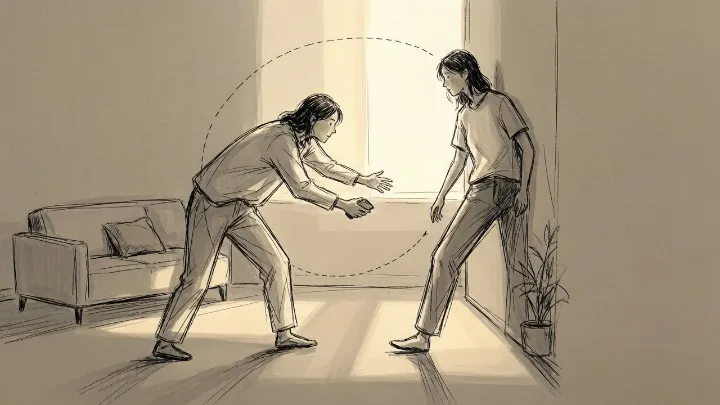
A note on the chemistry you sometimes feel right away: it’s not a sign of fit, it’s a sign of a familiar wound. Anxious attachers tend to be drawn to the emotional highs and lows of the chase. Avoidant attachers tend to be drawn to partners who are emotionally intense enough to feel real. The intensity itself feels like proof of love. It’s not. It’s proof of activation. The more polarized the styles in a pairing, the more dramatic the early phase, and the more brutal the middle.
If you want the longer version of the four styles and how they pair up, our attachment-styles primer covers the full map.
How do you identify your own attachment style?
No complex test required. Watch what you do under relationship stress.
When conflict rises, the anxious style reaches—more texts, demands for conversation, even a breakup threat to test commitment. The avoidant style retreats—silence, withdrawal, logic used to wall off feeling. The secure style states the need directly while leaving room for the other person. Fearful-avoidant flips between the two, sometimes within the same conversation.
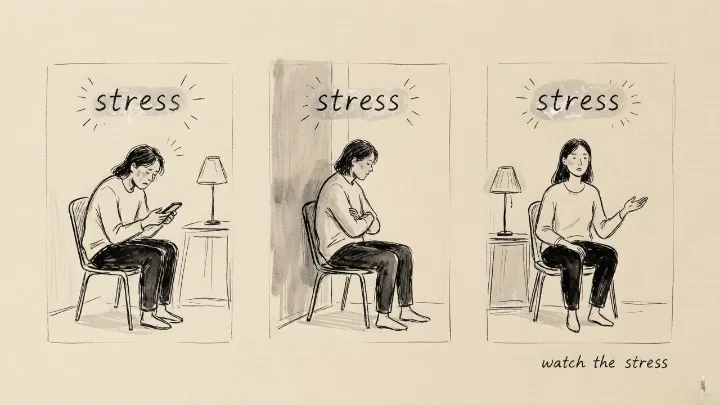
The point of knowing your style isn’t to label yourself. It’s to understand what fear is driving the behavior. A person who goes silent isn’t always being cold—their system may be sounding an alarm. A person who keeps asking isn’t always controlling—their fear may have just been activated.
A few quick self-checks worth running:
- After a normal disagreement, do you reach for your phone, or close it?
- When your partner is away for a few days, do you feel relief, anxiety, or both?
- Do compliments land easily, or do you suspect the giver’s motives?
- When someone gets close quickly, do you feel special or suspicious?
None of these answers are a verdict. They are data about the system you’re running. The system can be changed, which is what the next section is about. For the longer version, our anxious-attachment piece has more on the anxious side, and a separate piece on what to do with a partner who keeps pulling away is also worth bookmarking.
Can attachment styles change?
Yes, but it takes time and deliberate practice. Levine calls the goal earned secure attachment.
The shorthand: a person who didn’t start out secure, but who has thought about their patterns, done some work, and now operates from security most of the time, is operating in earned security. Research by Mary Main and Erik Hesse in the 1990s showed that adults who had adverse childhoods but who could talk coherently about what happened—what Main called autonomous state of mind—had relationships that looked much like the relationships of people who’d had secure childhoods. They weren’t pretending. The change was real, and it showed up in their kids, too.
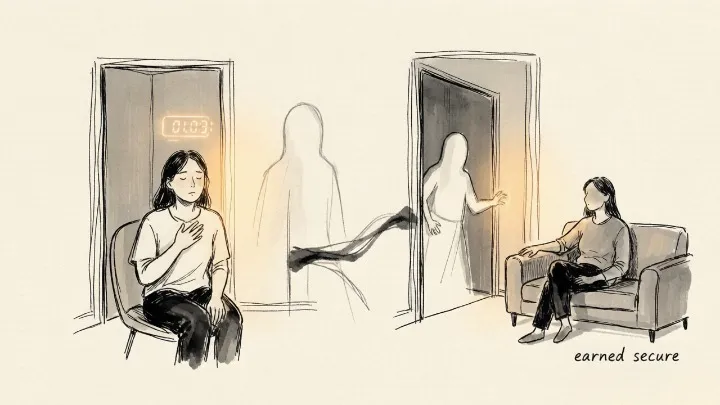
For anxious attachers, the core practice is self-soothing. When panic rises, resist the reflex to reach for the phone. Give yourself ten minutes. Bring attention back to your body and breath. Over time, the panic moves from a five-alarm fire to a low chime, and you can answer it on your schedule.
For avoidant attachers, the core practice is staying. When the urge to flee kicks in, stay one extra minute. Say something like: “I feel the urge to withdraw right now. It’s not about you.” Most avoidant people discover, after doing this a few times, that the world doesn’t end when they don’t leave. That’s the moment a small rewire begins.
For fearful-avoidants, the work is slower. The pattern is essentially oscillating between two fears—abandonment and engulfment—so the practice is noticing which one is loudest in any given moment, and choosing the next move from there instead of on autopilot.
The most useful thing Attached does is remove relationships from the courtroom of moral judgment. Our anxiety doesn’t make us weak. Their distance doesn’t make them cruel. Seeing the pattern is where the pattern starts to loosen.
Where the framework actually comes from
The book is a translation, not a discovery. The underlying science is older, and a short version helps explain why the patterns are so stubborn.
John Bowlby (1907–1990), a British psychiatrist, spent decades studying what happens to children separated from their primary caregivers. His trilogy Attachment and Loss (1969–1980) argued that attachment isn’t a luxury added on to a person, it’s a primary behavioral system, as basic as feeding or fleeing. Infants don’t get attached because they’re being cute; they get attached because the behavior keeps them alive.
Mary Ainsworth, an American developmental psychologist working with Bowlby in London, ran a famous experiment in Baltimore in the 1960s and 70s—the Strange Situation—that identified the styles by watching how babies responded when their mother left a room and came back. Secure babies protested and were easy to soothe. Anxious babies were hard to soothe even after the return. Avoidant babies acted as if nothing had happened. Ainsworth’s work is the empirical backbone of the whole field.
Cindy Hazan and Phillip Shaver translated the framework from babies to adults in 1987, in a paper that’s now one of the most cited in social psychology. They showed that people’s romantic relationships, at thirty-something, had the same shape as their relationships with parents at three. That finding has held up across cultures and decades.
Mario Mikulincer and Phillip Shaver have spent the last twenty years refining what happens when attachment gets activated under stress, and what helps it deactivate. The big finding: a partner who is consistently responsive, even in small moments, is the most reliable change agent. Not grand gestures, but the small, repeated answer to “are you there?”
Levine and Heller’s book sits on top of all of this. The contribution is the practical pairing logic—the four-style matrix for which combinations tend to work, which need work, and which to walk away from. If you’re interested in the deeper “why” of the patterns, Carl Jung and the Shadow Self approaches the same material from a developmental angle that’s worth a separate read.
FAQ
What if I score as one style with a partner and another with someone else? That’s normal. Most people aren’t a pure style. The system tends to activate the one that fits the partner’s behavior. With a more distant partner, the anxious side ramps up. With a more available partner, you might find a surprisingly secure side coming online. The style that’s loudest right now is the one to work on.
Can two anxious people make it work? Yes, but with effort. Two anxious partners often end up in a cycle of escalating reassurance-seeking. The danger is that no amount of reassurance is metabolized as enough. The fix is for at least one of the pair to slow down and steady themselves before responding. Two avoidant people can also work, but they need to consciously bring in warmth and small check-ins, because the default for both is to assume everything is fine.
What if my partner refuses to do any of this work? That’s a real limit, not a small one. You can change your own system, and that often changes the dynamic. But a partner who is openly dismissive of the framework, or who weaponizes your self-knowledge against you, is signaling something different. The book has a useful phrase: you can’t do the work for two people. If you want a structured read on relationship patterns you’re seeing live, the Kasamba love and relationship category collects live advisors who work in this exact territory. Use them as a sounding board, not a verdict.
Is this just pop psychology, or is there real science? Real science, with caveats. Attachment theory has thousands of peer-reviewed studies behind it. The four-style model is a simplification, useful for orientation but a poor fit for the messiness of actual people. A trained therapist, especially one who knows Emotionally Focused Therapy (EFT) or Internal Family Systems (IFS), will use the same map but with more nuance. For something more serious than self-study, a good couples or individual therapist is worth the money.
What if I had a secure childhood but I’m now anxious in this relationship? That can happen. A highly anxious partner can pull a secure person out of security over time. The first move is to name the dynamic out loud, and to ask the more anxious partner what they’re really afraid of. Often that conversation alone changes things. If it doesn’t, the more secure partner has to decide how much accommodation is healthy, and that’s where the framework gets hard.
How long does earned secure attachment take? Most of Mikulincer and Shaver’s longitudinal work on attachment dynamics suggests meaningful change in 1–2 years of consistent practice, with a therapist or a serious self-directed routine. Small changes happen much faster—the first time you don’t reach for the phone when panic rises, that’s already a shift. The deeper rewire is slower, and it’s not linear. There will be good months and bad months. The bad ones aren’t a sign of failure; they’re a sign of system memory.
A small, concrete starting point
If this is your first time reading about attachment, don’t start by trying to label your partner. Start with one question about yourself, asked honestly:
- What is the first thing I do when I sense distance in this relationship?
If the answer is “I reach for them,” that’s an anxious pattern worth watching. If the answer is “I shut down and start looking for the exit,” that’s an avoidant pattern. If the answer is “I sit with it for a minute and then ask what’s going on,” you’re already in earned-secure territory. None of these is a verdict on the relationship. They’re data about the system you’re running.
A small practice for the week: pick one moment you felt activated this week—the argument, the unanswered text, the partner who came home flat. Write down what you felt in your body first (chest, throat, stomach), then what story you told yourself about what it meant. The point isn’t to be right. The point is to notice the gap between the body and the story. That gap is where earned security grows.
Levine isn’t telling anyone to become a different person. He’s saying something simpler: the way you love now is mostly the way you were first loved. If you can see it clearly, you can change it slowly.
Core framework from Amir Levine and Rachel Heller, Attached. The book also includes a detailed attachment style quiz and communication strategies for each pairing type. Underlying science from John Bowlby, Mary Ainsworth, Cindy Hazan & Phillip Shaver, and the ongoing work of Mario Mikulincer. For a deeper read on the “why” of the patterns, see Carl Jung and the Shadow Self — same material, different door.