Carl Jung's Shadow: The Psychology Concept That Explains Your Darkest Reactions
For education and self-reflection only — not medical, psychological, or psychiatric advice. If you're in distress, please talk to a licensed professional. Full disclaimer.
What you can’t face in yourself, you’ll keep meeting in other people.
TL;DR
What we actually know is this: the shadow, in Jung’s framework, is everything about yourself that you’ve learned to reject — not because it’s evil, but because it didn’t fit the persona you were trained to perform. The denied material doesn’t disappear. It finds other ways to surface, most often as projections onto other people, as unexplained emotional overreactions, or as a recurring cast of irritating characters who follow you from job to job. The work isn’t to defeat the shadow. It’s to make room for it, which usually means withdrawing one projection at a time. The single most useful sentence: that thing I can’t stand in them — some version of that exists in me too. That acknowledgment is the entire leverage point.
What did Jung actually mean by “the shadow”?
The shadow is not some evil twin lurking in the basement of the psyche. It’s simpler—and more uncomfortable—than that.
The shadow is everything about yourself that you’ve learned to reject. Traits you were shamed for as a child. Desires you decided were unacceptable. Emotions you were told made you weak. None of this material disappears when you push it away. It goes underground and finds other ways to surface.
Jung’s observation: the more vigorously you deny a trait, the more power it gains over you. The person who insists “I’m not an angry person” is often the one whose rage erupts unpredictably. The person who prides themselves on never being jealous is often the one obsessively checking their partner’s phone. Denial doesn’t erase the shadow. It hands the shadow the keys.
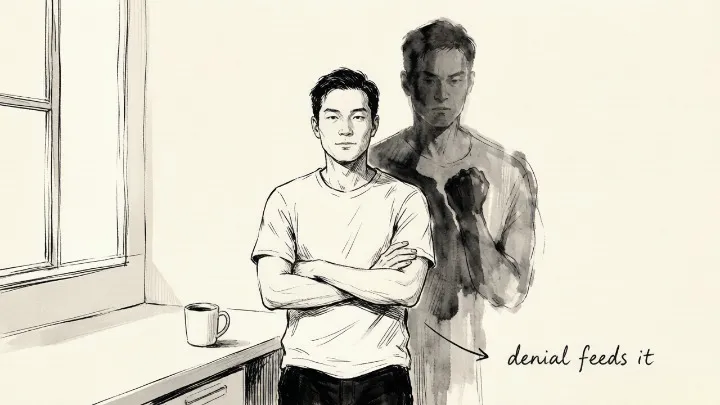
A useful reframing: the shadow isn’t a thing. It’s a relationship — between who you decided to be and everything that got left out of the decision. Most of the time, that relationship is unconscious. The work of making it conscious is what Jung called individuation, and it’s slower and less dramatic than the word suggests. It’s mostly noticing. For the longer version of the practice, our shadow work guide is the entry point.
Why does the shadow matter in everyday life?
Because the shadow doesn’t stay hidden. It projects.
Projection is Jung’s term for what happens when we unconsciously offload our unwanted traits onto other people. The coworker whose arrogance drives us up the wall might be showing us our own suppressed ambition. The friend whose neediness irritates us might be reflecting our own disowned longing for connection.
Projection creates a peculiar kind of blindness: we can spot a trait with laser precision in someone else while being completely unable to see it in ourselves. The louder the emotional reaction to another person, the more likely something personal is being stirred. Our piece on what Jung really meant by projection walks through the same mechanism in more depth, including the modern extensions of Klein and Fairbairn.
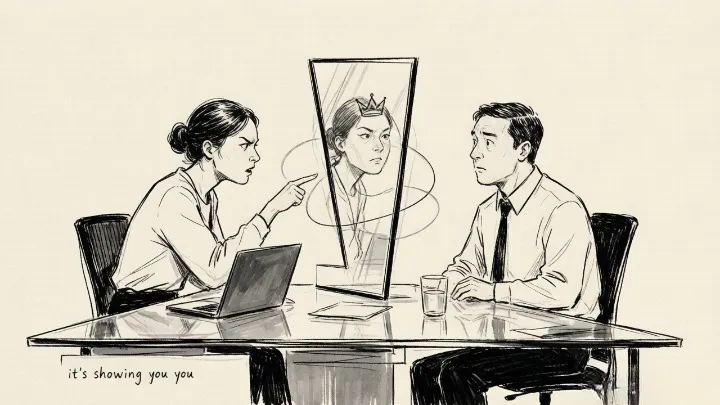
There’s a useful clinical note here. Research by cognitive psychologists — including work by John Darley and Paget Gross in the 1980s on the fundamental attribution error — shows that we’re much faster to assign traits to others than to recognize them in ourselves. That’s not a moral failure. It’s how attention works under load. The shadow gets a free pass because noticing it is metabolically expensive; projecting it onto someone else is fast and feels safe. Knowing this is half the leverage — the overreaction in the moment is not a sign of having a wrong feeling, it’s a sign of having the right feeling about the wrong target.
How can you recognize your own shadow material?
The shadow won’t announce itself. But it leaves a trail.
Follow the emotional overreaction. When someone’s behavior provokes a response that feels outsized—fury at a minor slight, contempt for a stranger, disproportionate irritation at a colleague—pause and ask: what exactly about this person bothers me? Now ask the harder question: is there any version of that trait in me that I don’t want to acknowledge?
Notice who you judge most harshly. The judgments we pass on others are often disowned self-judgments. A person who considers themselves exceptionally rational may have particular contempt for people who seem emotional—not because emotionality is objectively bad, but because they’ve spent a lifetime suppressing their own.
Track your recurring frustrations. If you keep running into the same irritating personality type—different jobs, different cities, different social circles—the common denominator is you. The shadow is loyal. It will keep arranging the same encounter until you finally look at it.
Watch for the people you secretly admire in ways that surprise you. A surprisingly common entry to shadow material is the trait you admire in someone but couldn’t possibly want for yourself — the visible ambition, the obvious sensuality, the unapologetic anger. The admiration is often a quieter form of the same longing. Jung wrote about this in Aion (1951): the shadow is not a moral question. It is a question of self-knowledge. For a more architectural view of the patterns underneath these recognitions, our 12 classic Jungian archetypes piece maps the most common configurations the shadow takes.
Pay attention to the jokes that land. The thing someone laughs at, the cartoon they share, the sitcom character they quote — these are often small windows into traits the conscious self is happy to enjoy from a safe distance. Noticing them is data.
The shadow at scale
Jung’s shadow is a private, internal matter. But it has a public face, and psychology has a name for it: the dark triad — Machiavellianism, narcissism, and psychopathy. The overlap isn’t a coincidence. All three are what happen when disowned shadow material hardens into a way of operating on other people.
Machiavellianism is the shadow’s capacity for instrumental manipulation — treating people as tools, computing relationships by what they can be made to yield. Narcissism is the shadow’s need for external validation — a self too fragile to hold together without a constant feed of admiration. Psychopathy is the shadow’s absence of remorse — the part that can hurt someone and register no debt for it.
Jung would have called these unexamined shadow, lived out loud instead of looked at. What’s new is the scale. The same manipulation that once required a face-to-face charm offensive can now be automated, laundered through a feed, and aimed at thousands of people at once. That’s not a new kind of evil. It’s the old shadow wearing new machinery.
The recognition signals are the same ones you’d use on your own shadow — follow the overreaction, notice who you judge, watch what returns. The narcissist signs piece maps the personal version in detail, and gaslighting covers the tactic that most reliably makes you doubt the recognition itself.
What do you do once you recognize the shadow?
Nothing dramatic. You don’t need to integrate, heal, or transform anything. The single most powerful thing you can do with shadow material is acknowledge that it’s yours.
Jung called this “withdrawing projections”—taking back the traits you’ve been outsourcing to other people. It doesn’t require a ceremony or a breakthrough. It happens the moment you say: “That thing I can’t stand in them—some version of that exists in me too.”
That acknowledgment shifts something structurally. The shadow loses some of its grip. The people who used to provoke you become less charged. And you gain access to energy you were spending on denial—energy that can now go toward being more whole. You don’t defeat the shadow. You make room for it. And making room for it is how it stops running the show.

A practical note about the sequence. The withdrawal of a projection usually happens in three steps, and they don’t always go in order:
- Spot the overreaction. That’s the entry signal.
- Find the trait in yourself. Not as confession, but as fact. I can be that. Sometimes this takes a few days of sitting with the recognition.
- Name it to yourself, in your own language. “I’m hard on her because I have that neediness too.” The naming is the action. The behavior often follows.
The work is not the same for everyone. Some people do well with journaling, some with a long walk and a recorded voice memo, some with a trusted friend who’s also doing the work. If the material that surfaces is heavy — old trauma, intrusive thoughts, dissociative episodes — a trauma-informed therapist is the right place to start. Shadow work is a complement to good therapy, not a substitute. For the long-form version of this practice, our shadow work guide walks through it step by step, and the related childhood trauma piece goes deeper on the specific case where the shadow has roots in early life.
If you’d like a sounding board for what you’re seeing in yourself, the Oranum tarot home collects live advisors who work in symbolic and introspective territory. Use them as a mirror, not a verdict.
Where Jung actually got this
The shadow is one of Jung’s central ideas, developed across his work in the early 1900s and named most directly in his later writings on individuation — the lifelong process of becoming fully yourself. Jung’s point was deceptively simple: the personality you show the world (what he called the persona, or “mask”) is only half of who you are. The other half — everything that didn’t fit the mask — goes into the shadow.
Crucially, Jung did not see the shadow as evil. He described it as morally neutral — a container for both our rejected “negative” traits and undeveloped gifts: the ambition the “nice girl” wasn’t allowed to have, the anger the “good boy” learned to swallow, the creativity buried under a life of being responsible. The shadow holds the parts of you that never got to be.
This is why Jung insisted the work isn’t about defeating the shadow — it’s about meeting it. You don’t become good by suppressing your shadow. You become whole by integrating it.
The shadow sits in a wider family of Jungian ideas. The persona is the social mask; the anima and animus are the unconscious feminine side in a man and the unconscious masculine side in a woman; the Self is the larger organizing pattern that includes the shadow. Individuation is the process of bringing all of these into a working relationship. The shadow is the entry point because it’s the one that shows up in everyday friction first — the rest requires more deliberate work to see.
The full how-to is here: Shadow Work for Beginners: A Complete Guide.
Frequently asked questions
Is the shadow evil? No. Jung was explicit that the shadow is morally neutral — a container for whatever the conscious self rejected, including positive qualities. The danger isn’t the shadow itself; it’s unexamined shadow, which operates outside your awareness.
How is shadow work different from therapy? They overlap but aren’t the same. Therapy is a structured, licensed relationship for mental health; shadow work is a self-reflective practice rooted in Jung’s framework. Shadow work can complement therapy — and for heavy material, it should be done with therapeutic support, not instead of it.
How do I actually start? Start small: journal on the three questions in the section above (overreaction, judgment, recurring frustration). Name one disowned trait out loud. You don’t need a ritual — you need honesty. The complete guide has ten structured prompts.
What if it feels overwhelming? Take it slower, and get support. Shadow work surfaces difficult material, and if it’s destabilizing, that’s a signal to work with a therapist rather than alone. The goal is integration, not flooding yourself. If you’ve had trauma in your background, the childhood trauma piece is the read that goes with this one.
Does this work if I don’t believe in Jung’s metaphysics? Yes, with a small reframing. The shadow as a metaphor for “the parts of myself I haven’t looked at” is what most modern practitioners actually use. The work is empirically useful — it changes behavior, relationships, and self-knowledge — whether or not you believe the unconscious is a literal structure. Cognitive-behavioral approaches have independently arrived at similar territory (e.g., schema therapy, parts work in IFS). For more on the cognitive-science side, our anxious-attachment guide covers a related territory from a different angle.
How long does shadow work take? Most people notice small shifts within a few weeks of consistent practice. The deeper work is years, and it isn’t linear. The shadow has many layers, and the early gains are real but small. The encouraging part: the first projection you successfully withdraw changes the way you see every future one. You don’t have to do all of them at once. You have to do the next one.
More in this cluster: Shadow Work Guide · Projection: Why Other People’s Flaws Make You So Angry · Shadow Work for Childhood Trauma · 12 Classic Jungian Archetypes · Tarot Archetypes: The Jungian Psychology Behind the Major Arcana — same material, different door.