Why Do Other People's Flaws Make Me So Angry? What Jung Really Meant by 'Projection'
For education and self-reflection only — not medical, psychological, or psychiatric advice. If you're in distress, please talk to a licensed professional. Full disclaimer.
The things we most fiercely reject in others are usually the parts of ourselves we can least bear to admit.
TL;DR
What we actually know is that projection is a normal psychological process, not a moral failing. Carl Jung described it as the psyche’s way of relocating unwanted material — a trait, a feeling, a desire — out of conscious ownership and onto something or someone “out there.” When that someone happens to be a real human, we then experience our own disowned content as their flaw, their character, or their fault. The mechanism has been written about since Jung’s work in the early 20th century and remains a working concept in modern psychotherapy, though researchers now describe it in slightly more clinical language. The everyday fingerprint is a triad: strong reaction, repeating pattern, and a specific kind of person it lands on. Catching it is mostly a matter of slowing down long enough to ask the question we usually skip — do I have any of this in me?
What does Jung mean by “projection”?
Projection is one of the easiest Jungian ideas to spot in everyday life. In plain terms: we take the traits, desires, or emotions that belong to us but that we refuse to own, and we “throw” them onto someone else.
Here’s an example. Say a person feels ashamed of the aggression inside them, because they were taught from childhood that “you must never lose your temper.” As an adult, they feel an outsized disgust toward people who speak bluntly or show their anger. They’ll say, “That person is so aggressive — it’s unbearable.”
Jung would argue they aren’t reacting to the other person at all. They’re reacting to their own suppressed aggression. The other person is just a screen, and their shadow has been projected onto it.
The mechanism is older than Jung’s vocabulary for it. He gave it a clinical name in The Archetypes and the Collective Unconscious (Collected Works, Volume 9i) and described projection as a normal move the psyche makes when it cannot yet metabolize a piece of itself. Projection, in his framing, is not a bug — it is an interim solution. The cost is that you stay strangers with the part of you that needed integration in the first place.
Projection is essentially a filtering mechanism. Because our shadow content is too painful to face, the mind “outsources” it to the outside world. That way we get to experience our own darkness as something “out there” — as other people we dislike — without ever having to admit it’s ours.

What does projection look like in daily life?
Three features tend to give projection away: a disproportionate emotional charge, a repeating pattern, and a specific type of person it lands on.
“Disproportionate emotional charge” means our reaction to someone is wildly out of step with the situation. Someone is five minutes late, and we explode. That almost certainly isn’t about the lateness — it’s because they’ve brushed against an old wound around “not being respected.”
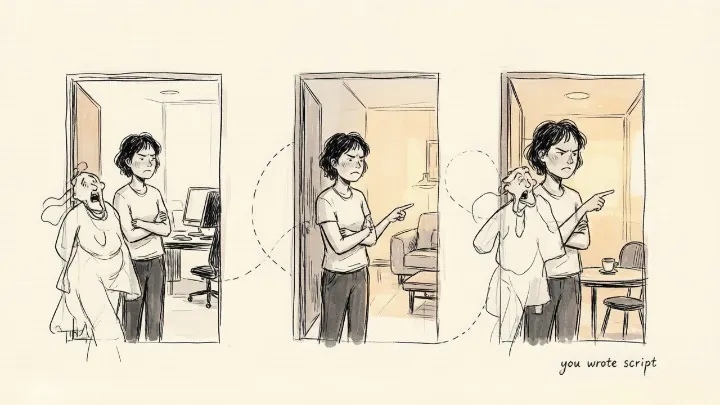
“A repeating pattern” means we keep getting triggered by the same kind of person. No matter how many jobs we change, there’s always that “irresponsible coworker.” No matter how many friends we make, there’s always that “attention-seeking show-off.” When the same script keeps playing out in different settings, odds are we’re the ones writing it.
The feature that helps us locate the shadow most precisely is “landing on a specific type of person.” Jung pointed out that the traits we notice most easily in others are exactly the parts of ourselves most in need of integration. Someone who has repressed their own ambition will be hyper-sensitive to “show-offs.” Someone who won’t allow themselves to be vulnerable will have zero patience for “drama queens.”
Worth noting here that modern psychotherapy has refined the term. The British psychoanalyst Melanie Klein introduced a related but distinct concept called projective identification — a more active, interpersonal version of the process, where the projector pulls the other person into a role that confirms the projection. Most everyday instances of what people casually call “projection” sit closer to Jung’s original, intrapsychic definition; Klein’s version is more clinical and rarer. Knowing the difference matters mostly if the term comes up in a therapeutic context.
How do I know I’m projecting?
The hardest part of projection is that we may be describing the other person’s trait perfectly accurately. That coworker may genuinely be irresponsible. That friend may genuinely love the spotlight. The problem was never whether our observation is correct — it’s the intensity of the reaction.
Here’s a practical check. The next time you feel a strong aversion to someone, ask yourself two questions. One: do I have this trait myself? Two: if I did, how would I judge myself for it?
If the answer to the first is “maybe a little,” and the answer to the second is “I’d hate myself” — projection is almost certainly at work. It’s not that the other person lacks the trait; it’s that half of our anger at that trait is coming from inside us.
A more clinical framing helps here. The British psychoanalyst W.R.D. Fairbairn, working in the mid-20th century, argued that what gets called “projection” is often a sign that an internal object relation has been re-activated — that the other person is briefly standing in for someone from an earlier chapter of our life. That doesn’t invalidate the everyday check above; it just means the pattern usually has roots older than the current situation. Awareness of the depth isn’t necessary to start the work. Noticing the heat is enough to begin.
For a fuller account of the underlying framework — what Jung meant by the shadow, how it relates to projection, and why he insisted the shadow is morally neutral rather than evil — see Carl Jung’s Shadow, explained.

Frequently asked questions
Is projection always negative?
Not necessarily. We project desirable qualities too — usually onto people we idealize, fall in love with, or put on a pedestal. Jung didn’t restrict the term to traits we dislike. The mechanism is the same; only the valence is different. Over-idealizing someone you barely know is often a sign that you’re projecting unlived possibilities onto them.
How is projection different from just having a strong opinion?
By intensity and by pattern. Strong opinions don’t usually come with a physiological charge (a tight chest, a flash of heat, a jaw that clenches) and they don’t usually repeat with the same kind of person in different settings. If both are present, odds increase that something is being projected.
How is projection different from a real conflict?
It can coexist with one. You might genuinely need to confront a coworker who drops the ball. The signal of projection is the leftover heat after the work issue is solved — the inability to let it go, the disproportionate anger at unrelated small things they do. The issue is real; the charge is more than the issue can account for.
Can I stop projecting entirely?
Almost certainly not — projection is one of the basic moves the psyche makes. The goal isn’t zero projection; it’s faster recognition, and a habit of asking the question sooner rather than later. A useful primer is our Shadow Work for Beginners guide, which walks through ten reflection questions that pair well with this work.
What do I do once I spot it?
Spotting projection isn’t about beating yourself up. It’s about reclaiming the parts of yourself you’d “outsourced” to other people.
Jung called this “withdrawing projections.” Concretely: the moment a certain trait in someone triggers a strong emotion, pause. Pull your attention back from them and ask yourself, “In what form does this trait live in me? When did I first decide I wasn’t allowed to have it?”
You don’t need to answer right away. The question is the work. The moment you start asking it, the projection is already being withdrawn.
A practical version, for tonight. Think of the person who most reliably pushes your buttons. Write their name at the top of a page. Underneath, write the three traits that irritate you about them most. Now, next to each one, write: Where is this in me? Not “I’m just like them” — that’s a forced confession and it isn’t true. Something more like: “I also want attention, but I’ve decided I shouldn’t ask for it.” “I also avoid risk, but I’ve decided I should be the responsible one.” The sentence doesn’t have to be polished; it just has to be honest. Keep the page. Read it again in a week.
A few small cautions. First, withdrawing a projection doesn’t obligate you to act on the disowned trait. Becoming aware of your suppressed ambition doesn’t mean you have to quit your job. Awareness is the goal, not behavioral overhaul. Second, the work is uneven — there are days when you’ll see your projections clearly, and days when the heat will win. Both are normal; neither is failure. Third, this is not a substitute for therapy. If the same patterns keep showing up in close relationships and feel immovable, a trained therapist can be a useful witness. For more on how projections often run along archetypal lines, the 12 Jungian archetypes introduction shows which patterns tend to cluster together.
This is where shadow work and relationship psychology meet. Often what hurts in a relationship isn’t the relationship itself — it’s the part of ourselves we’d rather not see, glimpsed through it. Every flash of strong revulsion is an invitation to meet our own shadow.
This article is not a substitute for therapy. Sage Mercer is not a licensed mental health professional. If the patterns described here consistently interfere with your relationships, work, or sense of well-being, please consult a qualified therapist or counselor in your area.
Some links in this article are affiliate links; if you choose to use them we may earn a small commission at no extra cost to you. If you’d like a live space to work through the dream-and-symbol side of this work, Oranum’s dream and subconscious readers hold space for that kind of inquiry.
More in this cluster: Carl Jung’s Shadow · Shadow Work for Beginners · 12 Jungian Archetypes.