5 Shadow Work Prompts for Healing Childhood Trauma
For education and self-reflection only — not medical, psychological, or psychiatric advice. If you're in distress, please talk to a licensed professional. Full disclaimer.
Childhood wounds don’t speak—but they run your choice in partners.
TL;DR
There’s a quiet space here for you. The wounds we carry from childhood rarely announce themselves — they move through us as overreactions, as dread we can’t name, as the same hard pattern in every relationship. You don’t have to fix any of it today. You don’t have to understand it all. These five prompts are simply an invitation to sit with what’s been exiled, gently, at your own pace. Nothing here asks you to be healed. Only to be present with yourself, as you are.
How are childhood trauma and the shadow connected?
Jung believed that the feelings we couldn’t safely express as children get pushed into the shadow — and they stay there, frozen in time.
If anger got you punished, anger went underground. If sadness was met with ridicule, sadness became something to hide. As adults, these buried emotions don’t just sit quietly. They leak out in ways we don’t recognize as connected to old wounds. A sudden rage over a small slight. A paralyzing fear of abandonment when a partner seems distant. An aversion to a certain kind of person we can’t quite explain.
The psychiatrist Bessel van der Kolk put it plainly in The Body Keeps the Score: trauma isn’t only a story we remember; it lives in the body, in the muscles that brace and the breath that catches before we have a thought. Naming it is one step. Feeling it is the next one.
Shadow work offers a way to meet these old feelings on safer terms. Not to relive the trauma, but to stop letting it drive the car. And the patterns it lays down don’t stay locked inside you — they shape who you reach for, who you keep leaving, who feels familiar in a way that’s hard to explain. There’s a name for that map: attachment style, and it’s worth knowing yours before you begin.
What do you need before starting?
An uninterrupted hour and an agreement with yourself not to judge what comes up.
This isn’t about writing beautifully or solving anything. It’s about honesty. If the emotions get too intense, stop. There’s no prize for pushing through pain. Shadow work works at the pace the nervous system can handle — slower than you think, gentler than you’d expect. Go gently with yourself, especially in the first hour. The work is not a race, and you’re not behind.
Below are five prompts. Start with whichever one pulls at you.
Prompt 1: The forbidden emotion
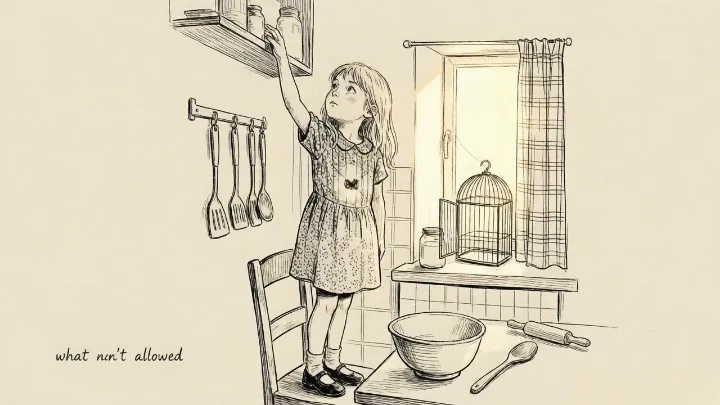
Think back to your childhood home. Which emotion wasn’t allowed? Anger? Sadness? Fear? What happened when you expressed it? Now ask yourself: as an adult, what do you do with that same emotion when it rises?
Notice what your body does before your mind answers — the chest tightening, the throat closing, the urge to laugh it off. That physical response is the trail back to the original moment. You don’t have to follow it all the way tonight. Just notice where it begins.
Prompt 2: The relationship rerun
Is there a conflict pattern that keeps showing up in your current relationships — romantic, work, or family? Does this pattern remind you of a dynamic from childhood? What are you afraid will happen again if you stop playing your usual role?
We tend to repeat what feels familiar, even when it hurts. If your first home taught you that love comes with conditions, you may keep choosing partners who set the same terms — without realizing you’ve been curating the cast. Naming the pattern doesn’t break it, but it puts a small light on it.
Prompt 3: A letter to the younger you
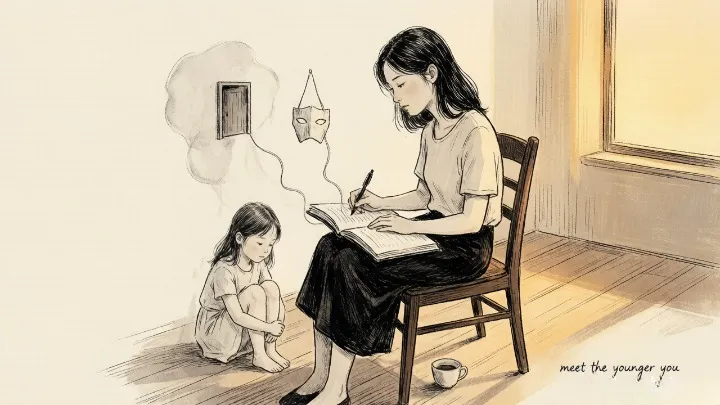
Close your eyes and picture yourself at the age when things were hardest. If your adult self could sit down next to that kid, what would you say? What does that younger version of you need to hear? Write it down. Write it like a real letter.
It doesn’t have to be long. A few sentences will do. “I see you. I’m sorry that happened. You didn’t deserve it.” Whatever you would say to a child standing in front of you right now — say it to the one you were.
Prompt 4: The mask you built to survive
What personality did you develop to protect yourself as a child? The good one? The funny one? The invisible one? That mask worked back then — it kept you safe. Is it still working now? Or is it keeping you from being fully known?
The mask is clever. It became so familiar you might not see it as a mask at all. Just a way of being. The question isn’t how to take it off — it’s whether you’d like to be seen without it, even once, even a little.
Prompt 5: The life you’d live if you didn’t have to please anyone
Imagine a world where you owe nobody anything. No parents to make proud. No partner to reassure. No friends to perform for. What would your day look like? What would you say no to? What would you finally choose?
This prompt is not a plan to act on. It’s an experiment in imagining. The freedom is in the noticing — what rises up when performance falls away. That image is yours, even if you can’t live it tomorrow.
What should you expect after doing these exercises?
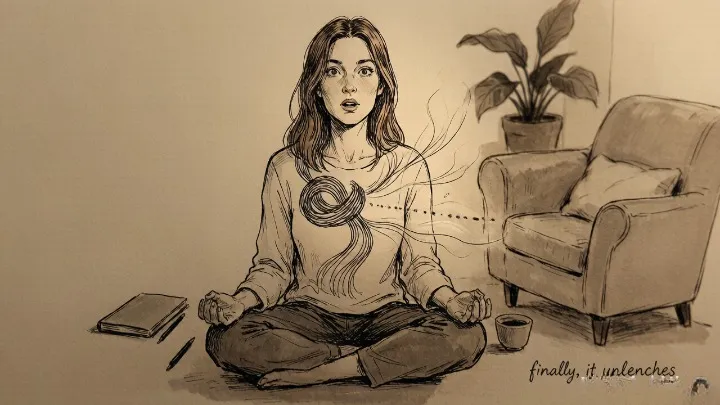
You might cry. You might feel anger you didn’t know was there. You might also feel a strange stillness — like something that was clenched for decades just unclenched a little.
All of these are normal. The point of shadow work isn’t to erase the past. It’s to bring the exiled parts of yourself back into view. When they’re visible, they don’t need to run things from the dark anymore.
A small practice for tonight
Pick the prompt that pulled at you most. Set a timer for ten minutes. Sit somewhere quiet. Write by hand if you can — handwriting slows the mind down, gives the censor less room to run interference. If nothing comes, write “nothing is coming” until something does. End by putting your hand on your chest for a slow breath, and thanking yourself for showing up.
A gentle note before you go
Some of these prompts touch old ground. If a memory surfaces that feels too big to hold alone, please reach out to a licensed therapist or counselor — that’s not a failure, it’s a wise next step. The work here is real, and so are you. You don’t have to do it without support.
Frequently asked questions
Do I need a therapist to do shadow work? Not necessarily. Many people begin on their own. But if old wounds feel tender, a trained companion can hold space in ways a journal can’t. There’s no rule against asking for help.
What if a memory feels too big? Stop. Breathe. Let the moment pass. You can always come back. If it keeps coming back uninvited, that’s a signal to talk to a professional — not because something is wrong with you, but because some things are too heavy for one pair of hands.
How often should I do these prompts? There’s no schedule. Once a week, once a month, once and done. The work tends to unfold at its own pace. Notice what feels sustainable.
Can shadow work make things worse? It can stir things up. If you feel more flooded, more numb, or more hopeless after a session, that’s information. Pause. Reach out. Slow down. The shadow has been there for years — it can wait a little longer.