AI Tarot vs Human Readers: What the Research Actually Shows
For education and self-reflection only — not medical, psychological, or psychiatric advice. If you're in distress, please talk to a licensed professional. Full disclaimer.
People rate AI empathy higher and still choose a human. That gap is where a tarot reading lives.
TL;DR
What we actually know is this: no study has put an AI tarot reader against a human one and scored the spreads. But the question that matters — do people want a machine’s understanding or a person’s — has been tested directly. In work published in Communications Psychology in 2026, researchers let people choose between empathy from a human and empathy from an AI. Fifty-seven to sixty-two percent chose the human, even while rating the AI’s responses as higher quality. The finding is uncomfortable and precise: people don’t pick the better answer. They pick the better presence. Tarot sits exactly in that gap, because a reading was never about the most accurate prediction. It was about being witnessed while you sort yourself out. A machine can generate the words. It can’t generate the being-there.
The question underneath the question
Ask “can AI do tarot?” and you get the wrong argument. People line up to insist the cards are either random or magic, and the AI either can or can’t read randomness. That’s a dead end, because it misunderstands what a reading is for.
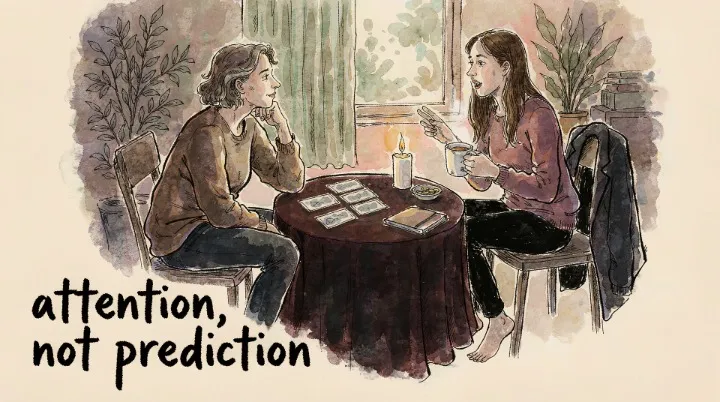
A tarot reading is a structured conversation in which a deck of images becomes a mirror. The reader’s job is not prediction. It’s attention. They watch which card makes your face change. They hear the sentence you start and don’t finish. They ask the question that rearranges the problem so you can see it from a different angle.
That is, mechanically, a form of what psychologists call therapeutic presence — the felt sense that another person is actually here with you, tracking you. And presence is the one thing research keeps finding that machines don’t quite deliver, even when their words are better.
What the research actually found
The most direct evidence we have is the empathy work led by Julian Wenger, Cameron Cameron, and Michael Inzlicht, published in Communications Psychology in 2026. The setup was simple. People received supportive responses, some written by humans and some generated by AI, and were asked both which they’d choose and which they thought was better.
Two results, and they point in opposite directions:
- On quality, the AI won. Its responses scored higher on feeling heard and on overall empathy. The effect was clear — significant at p<0.001, accounting for around 20% of the variance.
- On choice, the human won. Between 57% and 62% of people still wanted their support to come from a person.
Let the contradiction sit for a second. People could tell the machine was technically better, and they reached for the person anyway. That’s not a failure of information. That’s evidence about what people are actually buying.
The authors’ explanation lands on motive. A human’s empathy feels like it comes from genuine care; an AI’s empathy, however well-worded, feels like it comes from a prompt. We can register the difference without being able to articulate it. The paper’s shorthand is that people want to be cared for, not just responded to.
Why “better” isn’t the point
This is where the AI-vs-tarot debate keeps going wrong. Everyone asks whether an algorithm can out-perform a reader, as if a reading were a job interview where accuracy wins.
It isn’t. A reading is closer to what researchers call a ritual than to what they call a tool. The anthropologist’s insight is that ritual does most of its work not through the literal content but through the frame: a set-aside time, a person in a role, a question taken seriously, a space where it’s allowed to not know the answer yet. The cards are props in that ritual — useful props, but props.
You can feed the cards into an algorithm and get a perfectly structured interpretation back in half a second. What you lose is the ritual. No one pulls a card at random and feels seen. The feeling of being seen comes from another mind receiving what you just revealed and responding to it as if it mattered — which, in that moment, it does.
Where intuition actually enters
There’s a second reason the human part matters, and it’s the one people in the tarot world keep pointing at without naming: intuition is not the same thing as pattern-matching.
An algorithm reads the cards by probability. It knows that the Tower often means upheaval and the Lovers often means choice, and it combines them the way a well-read student would. That’s genuine pattern-matching, and it’s often correct.
But a reader reads the person. They notice that you flinched when the Five of Swords came up, that you laughed a beat too long at the question about your job, that your voice dropped when you described your mother. None of that is in the deck. All of it is in the room. The psychologist’s term for the body-level signal that arrives before conscious awareness is somatic marking — the sense that something is off or right before you can say why. An algorithm has no body, so it has no somatic markers. It reads your history; it can’t read your flinch.
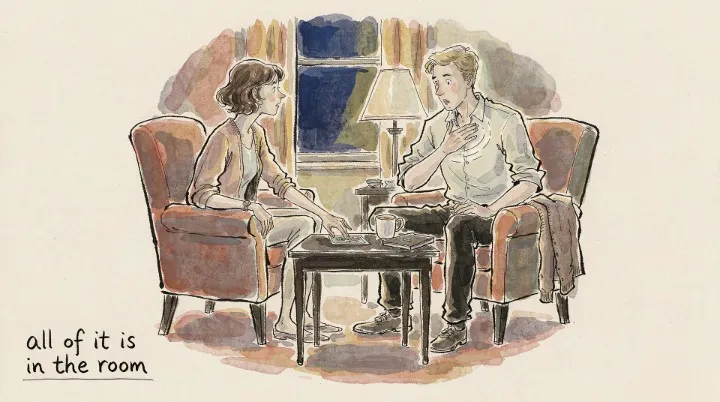
That’s the honest limit. It doesn’t make the human reader mystical. It makes them situated — in the same room, with the same nervous system, receiving the same unspoken information you’re broadcasting whether you mean to or not. If you want the practical version of how that inner signal works, our piece on the science of intuition walks through it without the woo.
The bridge: what a machine can’t be present for
Here’s the part worth sitting with. The research didn’t find that people are irrational for wanting a human. It found something more specific: people want a human because the human shows up, and showing up is not a content problem.
An algorithm can produce the most accurate reading imaginable and still fail at the one thing a reading is for — being a witness. There’s a reason people have gone to a trusted person with their questions for as long as there have been questions. It used to be the village elder, the confessor, the friend who reads your face better than you do. The form changes. The function doesn’t.
If you’ve been assuming tarot is about the cards, you’ve had it backwards. The cards are a door. The reading is the person on the other side of it. Our tarot for beginners guide is about the cards; this is about the person. The distinction is the whole point.
So the honest answer to “can AI do tarot?” is: it can do the deck. It cannot do the being-there. And for most people who sit down at a reading, being-there was the thing they came for.
If you want to feel that difference yourself — not read about it, but sit with a person who reads the cards and the room — Oranum’s tarot advisors work live on video, where the flinch and the pause are part of the reading. Watch one and decide for yourself what the algorithm left out.
Frequently asked questions
Can an AI actually generate a tarot reading? Yes, and reasonably well. It can interpret card combinations, draw on standard meanings, and phrase a response that reads as thoughtful. What it can’t do is notice the unspoken part — your hesitation, your tone, the card you didn’t want to see. A reading lives in that unspoken part.
Is there any direct research on AI versus human tarot readers? Not that we can name. The closest peer-reviewed evidence is the 2026 empathy work in Communications Psychology, which shows people rate AI empathy higher yet still choose human empathy. Tarot is a specific case of the same underlying thing: we want presence, not just output.
Does this mean AI readers are useless? No. They’re cheap, private, and always available, which is a real value for a first pass or a late-night question. The limit isn’t the information; it’s the relationship. Use an AI for the deck, and a person when what you’re actually after is being witnessed.
If it’s mostly the ritual, why pay for a human? Because the ritual is the product. People pay for the set-aside time, the role, the attention, and the feeling that someone genuinely received what they shared. That’s not a premium on top of the reading. That is the reading.
More in this cluster: Why People Choose Human Empathy Even When AI Ranks Higher · What an Algorithm Knows About You · The Science of Intuition · Tarot for Beginners — same territory, different door.