People Choose Human Empathy Even When AI Ranks Higher
For education and self-reflection only — not medical, psychological, or psychiatric advice. If you're in distress, please talk to a licensed professional. Full disclaimer.
We don’t reach out for the best answer. We reach out to be held by someone who chose to show up.
TL;DR
What we actually know is this: in 2026, researchers in Communications Psychology measured what happens when people choose between empathy from a human and empathy from an AI. The AI’s responses scored higher on quality — significantly higher, on both feeling heard and overall empathy. And yet 57 to 62 percent of people still asked for the human. The study points to the reason: empathy is not just the words. It’s the perceived motive behind them. We trust a human’s care because it seems chosen; we suspect an AI’s care because it seems generated. That distinction is not a flaw in human judgment. It’s the thing itself. When we hurt, we aren’t shopping for the most skilled response. We’re looking for someone who is actually there.
The paradox, stated plainly
Here’s the finding that should make you pause. Give people a supportive message and tell them it came from either a human or an AI, and the AI’s message wins on quality. The effect is strong — the paper reports it as significant at p<0.001, explaining roughly a fifth of the variance in ratings. The machine, by the numbers, is the better empathizer.
Then ask those same people who they want. The answer flips. Between 57% and 62% say they’d rather have the human.
This is not the result most people expect. The assumption in a lot of the AI conversation is that if the machine can do it better, the machine wins. What this study shows is that “better” isn’t the axis people are measuring on when it matters. When it matters, the axis is something else entirely.
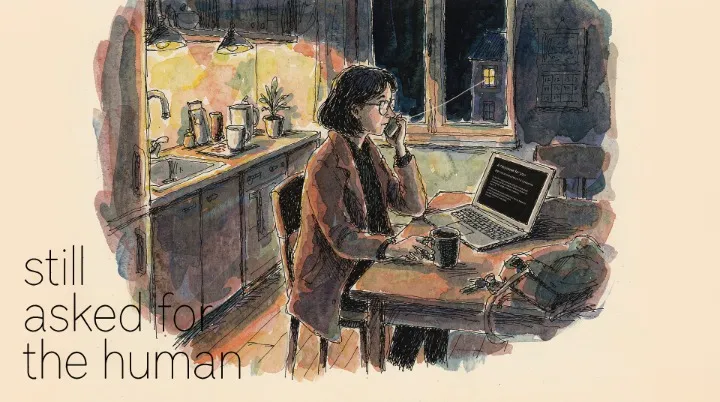
What people are actually choosing
The researchers’ explanation comes down to one word: motive. A human’s empathy feels like it comes from genuine care — a person who could have looked away and didn’t. An AI’s empathy, no matter how beautifully phrased, feels like it comes from an instruction. It can’t look away, because it was never looking in the first place.
That difference is invisible in the words but decisive in the choice. We can read a perfectly warm sentence from a machine and still feel, somewhere underneath, that no one wrote it. The warmth doesn’t land the same way when you know nothing behind it got cold first, or tired, or chose to stay anyway.
Think of the last time you were genuinely upset. The friend who helped wasn’t necessarily the one with the best advice. It was the one who showed up — who cleared the evening, who sat with the silence, who didn’t rush to fix you. Advice is cheap. Presence is what cost them something, and that cost is what you felt.
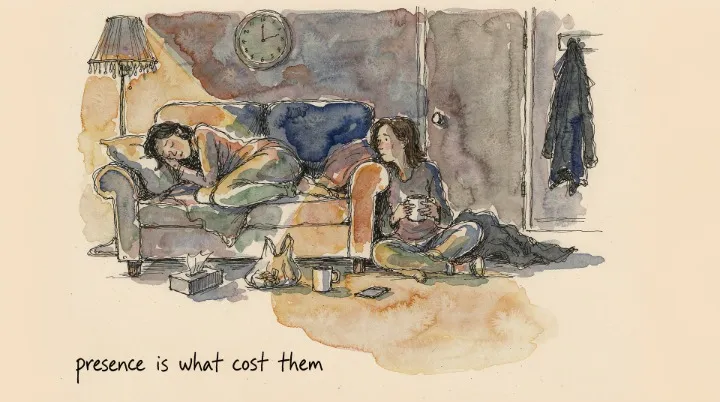
Why quality isn’t the point
There’s a deeper reason the “AI is a better empathizer” framing keeps missing, and it’s about what empathy is for.
A lot of people treat empathy as a skill — a set of techniques for saying the right thing at the right time. By that definition, the AI genuinely is better, because it never gets tired, never loses patience, never has a bad day. It can be optimally warm at four in the morning.
But the experience of being comforted is not the experience of receiving correct technique. It’s the experience of being joined. The psychologist’s term is attunement — the felt sense that another nervous system is tracking yours, moment to moment, and adjusting to it. That’s not a performance. It’s a state two people fall into together. A machine can describe attunement perfectly and still not be in it with you.
This is why the study matters beyond its headline. It’s not evidence that AI empathy is bad. It’s evidence that what we’re asking for when we’re hurting is a person, not a product — and we can tell the difference even when we can’t name it.
The bridge: the oldest name for being joined
Strip away the terminology and this is an old, old story. Human beings have always had a name for the thing the study is measuring — that felt sense of another person choosing to be with you in your difficulty. We built rituals around it. We built whole roles around it.
The confessor. The midwife. The healer who listens before they treat. The friend who keeps vigil. Every culture, going back as far as records go, has appointed someone to do the thing the machine can’t: to be present with another person’s pain, not to solve it but to hold it alongside them.
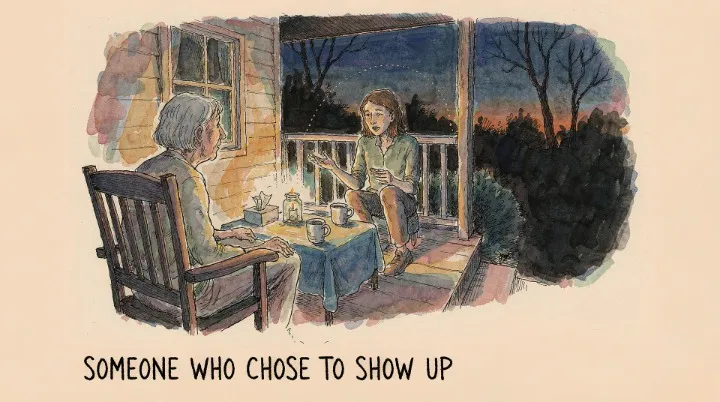
What the research is telling us, in statistical language, is that this need hasn’t gone anywhere. It survived the phone, the text message, the chatbot. If anything, the more our interactions get automated, the sharper the appetite for the one that isn’t. That’s not nostalgia. It’s a measurable preference.
If the language of energy and healing feels closer to this than the language of psychology does, there’s a reason. They’re pointing at the same thing from different sides. Our energy body piece names what it feels like when presence is working — not as a metaphor, but as a description of what a tuned-in person does to the room.
The thing people reach for when the AI offers a perfect sentence? It has always been available, and it’s never been a machine. It’s another person, paying attention on purpose.
If you’d like to sit with someone who practices that kind of attention — the listening that isn’t a script — Oranum’s advisors work live, one person to another. The point isn’t the perfect answer. It’s the being-there.
Frequently asked questions
Did the study really find AI empathy is better? On the specific metrics measured — feeling heard and empathy quality — yes, the AI responses scored significantly higher. But “higher quality” and “what people choose” turned out to be two different questions. People chose the human.
Why do people choose the human if the AI is better? The researchers point to perceived motive. Human care reads as genuine and freely given; AI care reads as generated on instruction. We trust the former and suspect the latter, and that trust is what comfort runs on.
Is this just about romanticizing humans? No. The point isn’t that humans are always better — most of us are inconsistent, tired, and clumsy at empathy. The point is that the reason we reach out is for a person, and the imperfect person still satisfies that reason in a way a perfect machine can’t.
What does this mean for AI companionship and therapy bots? It suggests they’ll be useful as supplements and first passes, but not as replacements for the core human need. The research doesn’t say AI empathy is worthless. It says it’s solving a different problem than the one we bring when we’re genuinely in pain.
How is this relevant to spiritual and healing practices? The thing being measured — another person choosing to be present with you — is exactly what healing and spiritual practices have always offered. The study gives a modern, peer-reviewed name to a function those traditions have carried for thousands of years.
More in this cluster: AI Tarot vs Human Readers · What an Algorithm Knows About You · The Energy Body · The Science of Intuition — same territory, different door.