What an Algorithm Knows About You (And What It Never Will)
For education and self-reflection only — not medical, psychological, or psychiatric advice. If you're in distress, please talk to a licensed professional. Full disclaimer.
An algorithm knows what you’ll do next. It doesn’t know what any of it is for.
TL;DR
What we actually know is this: a recommendation system holds a model of you that is, in a narrow sense, startlingly accurate. It knows what you’ll click, what you’ll buy, what you’ll stay up too late watching. It knows these things because it has watched your behavior at a scale no person ever could. What it cannot know is why any of it matters to you — the meaning, the longing, the reason a particular song or question or image reaches you. Pattern and meaning are different categories, and confusing them is the quiet error at the center of modern life. The machine can predict you. Only you — and the people who actually know you — can know you. That gap is worth getting precise about.
What the machine actually knows
Let’s be fair to the algorithm. It isn’t guessing.
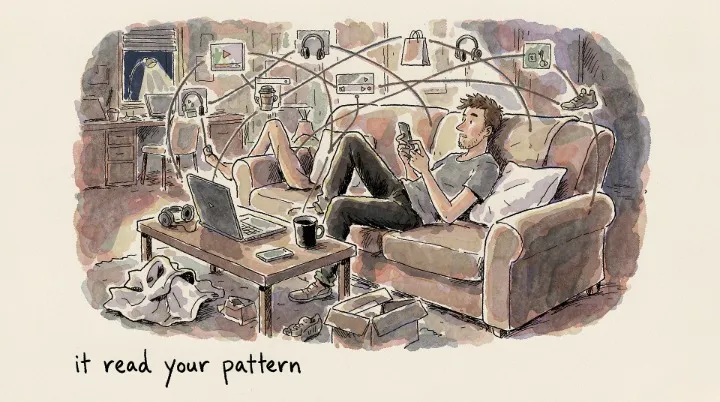
Every platform you use is building a running model of your behavior — what you pause on, what you skip, what you open at two in the morning, what you send to the friend you never send anything else to. Over enough time, that model gets good. Good enough that you have probably had the uncanny experience of being served an ad or a video that seemed to know something about you you hadn’t said out loud.
It didn’t read your mind. It read your pattern. And the pattern is real. The psychologist’s framework for this is the distinction Daniel Kahneman drew between System 1 and System 2 — the fast, automatic mind and the slow, deliberate one. Most of your online behavior runs on System 1. You scroll, you click, you react before you think. That’s exactly the layer an algorithm can model, because it’s automatic, consistent, and measurable. Our thinking-fast-slow piece unpacks that machinery in detail.
So the uncomfortable truth is: the machine has a better map of your automatic self than you do. Not because it’s smarter. Because it never looks away, and it never forgets.
What it can’t know, and why
Now the other side, which is where most of the “AI knows everything” panic goes wrong.
A pattern is a description of what you do. Meaning is a description of what it’s for. The algorithm can log that you search for tarot readings at eleven p.m. every Sunday. It cannot know that Sunday is when you finally stop being the version of yourself your job requires, and the question you keep circling is the one you’ve been too tired to ask all week. It knows the timing. It doesn’t know the weight.
This is not a mystical claim. It’s a category distinction. The philosopher’s word for the gap is aboutness — the fact that a thought or a feeling is about something, points at something, in a way a data point never does. A click is evidence. A longing is a direction. They live on different floors.
The machine can tell you’re anxious, because it can see you’re searching the same reassurance every night. It cannot tell you what the anxiety is about — because what it’s about is a story you carry, with a history and a cast of characters and a particular wound, and none of that is in the clickstream. You could hand the algorithm every message you’ve ever sent and it would still only know the shape of you, not the sense of you.

The error we keep making
Here’s the part worth sitting with. We have started to confuse these two things, and the confusion is doing real damage.
Because the machine predicts us so well, we’ve started to believe its model of us. We let the recommendation feed tell us who we are. We let the engagement numbers tell us what we care about. We let a system that can only see our automatic self stand in for the whole of us.
That’s the error. A model built on your System 1 behavior is a model of your habits, not your person. It knows what you’re likely to do. It has no idea what you’d do if you actually chose. The second thing — the choosing — is precisely what the machine can’t see, because it only ever watches you on autopilot.
The most useful skill of the next decade, if the research on self-awareness is right, is learning to tell those two apart in yourself: this is what I reflexively do versus this is what I actually mean. One is visible to any algorithm. The other is visible only to you, and only if you slow down enough to look. Our signs of intuition piece is, in one sense, a field guide to the second layer — the signal that doesn’t show up in the clickstream.
The bridge: what it means to be known
There’s a word for the difference between being predicted and being known, and we use it more than we notice. When someone predicts you, they see the pattern. When someone knows you, they see the meaning. That’s why being understood by another person feels categorically different from being profiled by a system — even when the system is, technically, more accurate about your behavior.
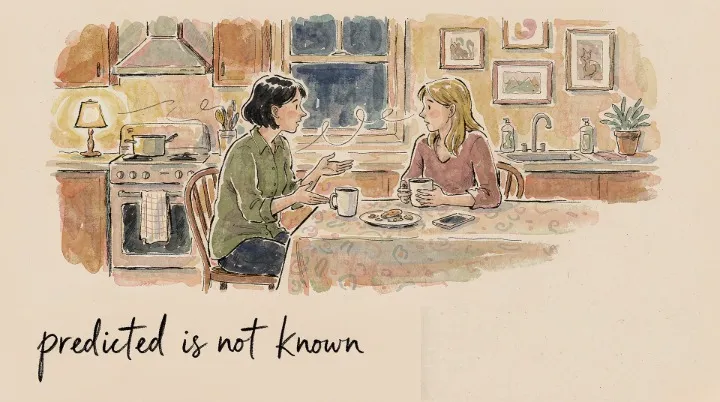
This is the oldest distinction in the spiritual traditions, wearing modern clothes. Every contemplative practice, in one way or another, is training for the second layer — the attention that goes beneath the habit to the meaning. The meditation teacher, the confessor, the elder: these are all people whose role was to see the part of you that the pattern misses.
The machine has given us an unexpected gift, actually. It has made the boundary vivid. The more precisely an algorithm predicts us, the clearer it becomes what it still can’t reach. And what it can’t reach — the meaning, the choosing, the being-known — turns out to be the part of you that was never automatable in the first place.
If you want to be met at the level of meaning rather than the level of pattern — the level a machine can’t operate on — Oranum’s live advisors sit with people one at a time, listening for the story behind the pattern. That’s the thing the feed will never give you.
Frequently asked questions
Is the algorithm really that accurate? At predicting behavior — yes, in a limited domain. It models your automatic, habitual responses, which are highly consistent. It is very good at knowing what you’ll do next. That is not the same as knowing you.
What’s the difference between pattern and meaning? A pattern is a regularity in behavior. Meaning is what the behavior points at — the story, the longing, the reason. An algorithm sees the first and is blind to the second, because the second lives in your history and your choosing, not your clickstream.
Why do we let the machine define us? Because its predictions are accurate and flattering to believe. When a system seems to know us, it’s easy to accept its model as the truth. But it’s a model of our habits, not our person. The confusion is the quiet error this article is about.
Is self-awareness actually trainable? Yes. The research on it is consistent: slowing down, reflecting, and distinguishing automatic reactions from deliberate choices is a skill that improves with practice. It’s not mystical. It’s attention, aimed inward, on purpose.
How does this connect to intuition? Intuition is often the name for the second layer — the felt sense that runs beneath the obvious pattern. It’s the signal an algorithm can’t log. The machine predicts; intuition orients. They’re complementary, not the same.
More in this cluster: AI Tarot vs Human Readers · Why People Choose Human Empathy · Thinking, Fast and Slow · 7 Signs Your Intuition Is Speaking — same territory, different door.